
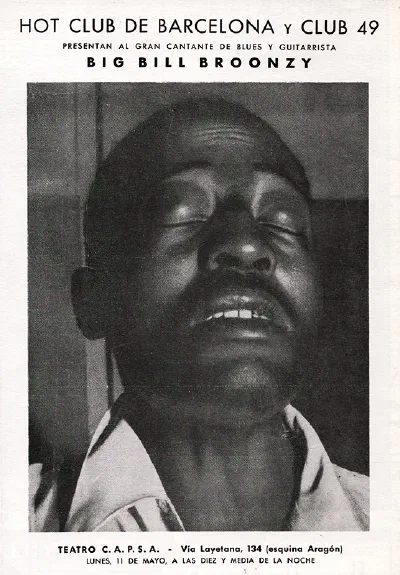
Big Bill in the background
Big Bill Broonzy is playing on a record player in the next room, while the sun lights up the living room where Joan Ventosa and I are interviewing Alfredo Papo. It is a cold, sunny January afternoon in 2007 in Barcelona’s Eixample, and the old patriarch of African-American music in Barcelona tells us, in a trembling voice charged with energy, about the arrival in the city of the legendary Big Bill Broonzy to give a concert at the city’s Capsa theatre.
According to official history, that night of 11 May 1953 was the first time authentic blues was heard in the city. But no one can be sure of that. Dates and labels of origin are the handrails that help us climb the stairs of history. What is certain is that this historic engagement, organised by the Hot Club de Barcelona and Club 49, drew a small but enthusiastic audience, with a huge hunger for new emotions.
On 31 October 1965 the American Blues and Folk Festival tour reached Barcelona’s Palau de la Música with the most select blues musicians of the moment: John Lee Hooker, Buddy Guy, Roosevelt Sykes, Big Mama Thornton and many others. In the mid-nineteen-sixties an underground movement began to emerge in the city, one that discovered the African-American music arriving in the sailors’ bundles, the tourists’ suitcases and the hippies’ rucksacks.
It would take until the 1980s, with the winds of change and the opening to modernity, for a home-grown blues scene to burst forth. In 1981 Vicente Zúmel launched L’hora del Blues, the longest-running radio programme of the genre in Spain, and the jams began at the Cova del Drac, an old temple of the Nova Cançó that would serve as a catalyst and a launch pad for the city’s first blues musicians.
In 2005 the Societat de Blues de Barcelona was born and, from the outset, it has brought together virtually all the musicians and fans in the city, marking a new qualitative and quantitative leap on the local scene. Jams proliferate; competitions, talks and festivals such as Primavera In Black or the Cicle de Blues & Boogie de l’Hospitalet are organised.
In 2020, the closure caused by the COVID-19 pandemic added more nails to the coffin in which many seem to want to bury live music. But Barcelona’s blues has lived through far worse times and is perfectly prepared to go on lighting up the shadows on the darkest nights of cultural banality.
In the background, Big Bill Broonzy is still playing.